Probably Stolen Guides
Help for the current Probably Stolen Steam Playtest, built on what the developer has published about how the shop works.
You run a pawnshop. Rent rises over time no matter what you do. You win by earning enough to buy the shop outright. Everything between those two facts is a series of judgement calls: what an item is really worth, whether the person across the counter is a customer or Security, and how much legal risk a margin is worth.
Published guides
Radioactive Waste Disposal Guide
Where players report taking it, a container workaround, and the limits of what is currently verified.
Community-sourcedRats: Traps, Butchering & Rat Wrangler
Catching rats, processing them for meat, reported Playtest prices, and the Rat Wrangler starting scenario.
Official patch notesTroubleshooting: Bugs, Fixes & Known Issues
Ultrawide and fullscreen, garbled text, softlocks and performance — matched to the exact patch that fixed them, plus what the Demo changes.
Preview-sourcedMoney: Make Money & Buy the Shop
The shop-buyout goal, the 15% markup, appraisal commissions and why rent decides every call — official facts kept apart from a single preview.
Screenshot-sourcedWater: Moisture Farm & Water Merchant
Producing, buying and trading water — the figures legible in the official screenshots, and the questions they leave open.
Getting startedAll 7 Starting Scenarios Compared
Gunsmith, Chemist, Water Merchant, Fence, Farmer, Rock Bottom and Rat Wrangler — what each one commits you to.
DemoRelease Date & How to Get the Demo
The October 28, 2026 launch date, and how to download the free Demo on Steam.
Before you playSystem Requirements & Steam Deck
Full minimum specs, and where Mac, Linux, Steam Deck and controllers stand.
ReferenceGame Wiki & Database
Every confirmed system, item and NPC in one index, each with its verification status.
How the shop works
Before any individual item guide, these are the four systems that decide whether a run survives. All four are documented by the developer, so you can plan around them from your first session.
1. Rent is a clock
Rent increases over time regardless of how well your week went. Falling behind reduces store attractiveness, which reduces customer traffic, which reduces revenue — widening the gap.
Falling behind compounds. Lower attractiveness means fewer customers, which means less revenue, which means you fall further behind. Protecting the weekly rent payment matters more than any single high-margin sale.
2. Profit comes from appraisal
Rare items need proper appraisal to avoid overpaying. Cigarette packs need visual inspection before resale. Suppliers overstate value.
The developer is explicit that “misjudge the item or the person selling it, and you absorb the cost.” Most losses happen at the buying counter. Cigarette packs need visual inspection, water needs testing and filtering, and weapons need permits before they are worth anything to you.
3. Every customer is a possible trap
Today’s customer could be Security fishing for evidence, a revolutionary seeking leverage, or a fallen elite testing your usefulness. Approve, refuse, report, or look away — someone is always taking notes.
You have four responses to any transaction — approve, refuse, report, or look away — and the game states that someone is always taking notes. This is where reputation comes from: reputation buys access and protection, but it also paints a target on your back.
4. Risk scales with margin, deliberately
Hide stolen goods and contraband from the authorities, or bribe your way out if you get caught. Contraband brings raids.
The high-margin routes are gated behind licenses: unlock advanced licenses to access the underground market. some trades need heavy machinery and permits.Faction relationships open exclusive deals on top of that. The rule of thumb the design pushes you toward is that the better the margin, the worse the failure.
Guides in progress
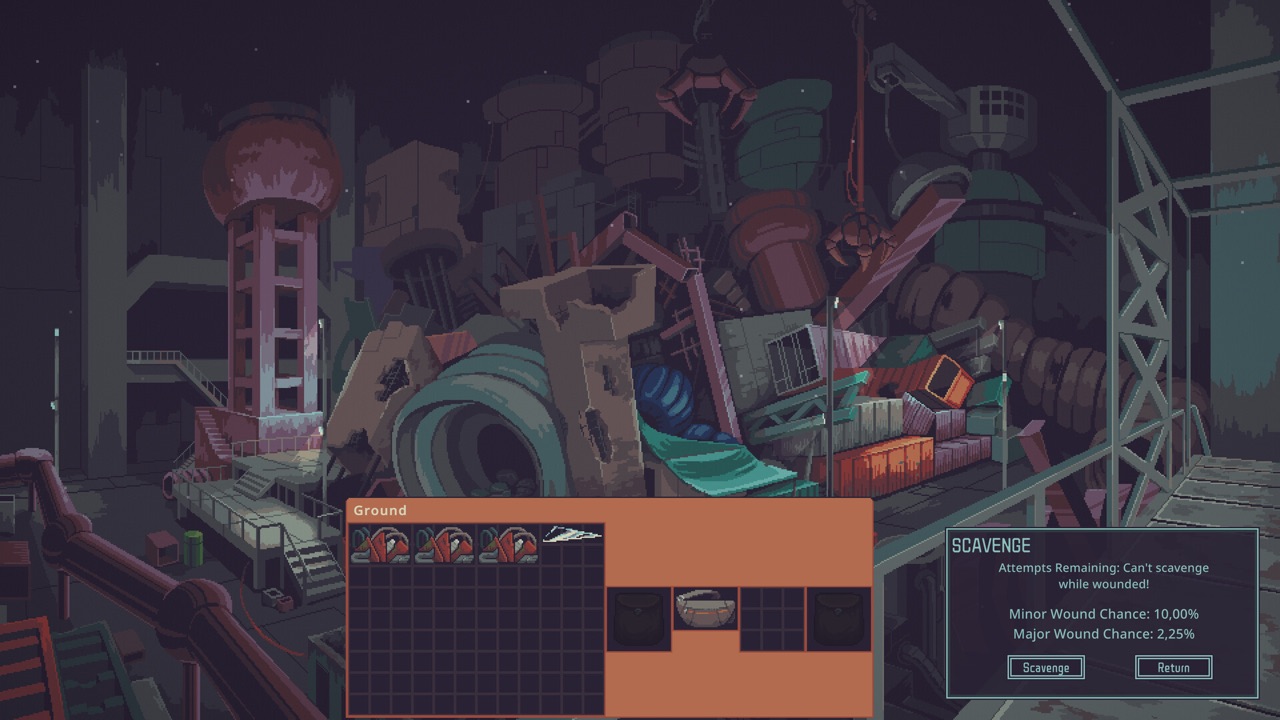
Scavenging is one of the routes still being written up. The screenshot above already prices the risk: a 10.00% minor wound chance and a 2.25% major wound chance per attempt, and the panel locks you out once you are hurt — “Can't scavenge while wounded”. What the site yields, and how a wound clears, are still open.
Each of these is waiting on either a reproducible in-game result or a specific, attributed player report.
| Guide | What it will answer |
|---|---|
| Beginner guide | A concrete plan for surviving your first in-game week |
| Augs | The tells that identify an infected customer before it costs you |
| Bartering | How the haggling interface works and when to push |
| Becoming a fence | Unlock requirements and the contraband risk curve |
| Items & prices | A full item table with buy and sell values |
| NPC list | Who each named character is and what they trade |
Probably Stolen gameplay FAQ
What is the goal in Probably Stolen?
To earn enough money to buy out your shop before rising rent forces your hand. Rent increases over time regardless of how well your week went, so standing still is losing.
What is the best starting path in Probably Stolen?
There is no best path. The store description says every product line has its own way of ruining you, but it names the consequence for only four: weapons draw inspections, chemicals bring addiction, water carries liability, contraband invites raids. Pick the consequence you would rather manage. Produce is the one named line it attaches no consequence to, Rock Bottom is given no product line at all, and Rat Wrangler has no product line, consequence or starting conditions published for it.
How do you make money in Probably Stolen?
By buying below value and selling above it, which depends on appraising items correctly. Suppliers overstate value, rare items need proper appraisal to avoid overpaying, and misjudging an item means you absorb the cost.
What happens if you cannot pay rent in Probably Stolen?
The spiral is spelled out on the store page: your store loses attractiveness, fewer customers come in, revenue drops, and the gap widens. Recovering usually means taking riskier deals to stabilise cash flow.
Should you sell counterfeit goods in Probably Stolen?
It is an explicit option — you can cut product quality, relabel counterfeits as genuine, or fence stolen goods. The trade-off is that any customer might be Security fishing for evidence, and there is mob justice on top of official enforcement.
Sources
- Probably Stolen on Steam — official system descriptions quoted throughout
- Probably Stolen Steam Discussions — open player questions driving the guide roadmap